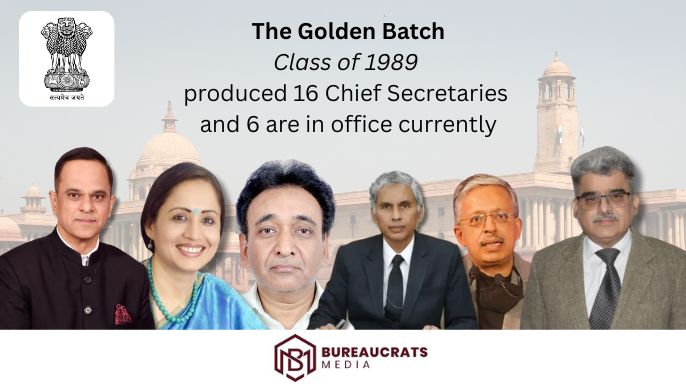
The remarkable IAS batch of 1989 has delivered an extraordinary administrative milestone by producing a total number of 16 Chief Secretaries over the years. A rarest of rare things to happen!
10 of these 16 stalwart officers who held the highest post in state bureaucracies have already moved on after completing their tenure. These officers include Amritlal Meena (Bihar), Shivdas Meena (Tamil Nadu), Dharmendra (Delhi), Santhi Kumari (Telangana), Somesh Kumar (Telangana), Rebecca Suchiang (Meghalaya), TT Toy (Nagaland), Pavan Borthakur (Assam), BP Gopalika (Bengal), and Pankaj Joshi (Gujarat).
The other Six distinguished officers produced by this golden batch of 1989 currently helm the bureaucracy in Uttar Pradesh, Madhya Pradesh, Rajasthan, Maharashtra, Karnataka and Jammu & Kashmir.
Such outcomes are never accidental. They are shaped by years of perseverance, discipline and the quiet resolve that defines the civil service at its best. Surrounded by peers of equal caliber, these officers appear to have inspired one another to greater heights — turning a strong batch into a genuinely historic phenomenon!
Together, the six Chief Secretaries currently oversee governance for about 61 crore people — more than 40% of India’s total population. The scale of responsibility they collectively shoulder is immense, and their leadership sits at the heart of administration across some of India’s most politically and economically significant states and union territories.
Here’s a glimpse into their individual journeys.
Anurag Jain — the 35th Chief Secretary of Madhya Pradesh — brings to the role a blend of technical depth, policy exposure, and a calm administrative temperament shaped over three decades in public service.
A 1989-batch IAS officer of the Madhya Pradesh cadre, Jain took charge as Chief Secretary on 3 October 2024. Born in Gwalior, he is an alumnus of IIT Kharagpur, where he completed his B. Tech in Electrical Engineering, and the Maxwell School in the United States, from which he earned a Master’s in Public Administration — a combination that has long informed his analytical and reform-driven approach.
His career has traversed key positions across the state and Centre. From serving as Collector in Mandla, Mandsaur and Bhopal to holding senior roles such as Finance Secretary, Additional Chief Secretary, and Secretary to the Chief Minister, Jain has been central to several phases of the state’s administrative evolution. At the national level, his tenure as Joint Secretary in the Prime Minister’s Office and later as Secretary in the Ministry of Road Transport and Highways broadened his exposure to complex policymaking and national infrastructure development.
Jain has also been recognised for championing e-governance, earning the “Web Ratna Award” for initiatives that enhanced digital delivery and institutional efficiency.
Since assuming the top bureaucratic position in Madhya Pradesh, he has placed emphasis on timely service delivery, tighter administrative discipline, and stronger inter-departmental coordination. His one-year extension, now taking his tenure through August 2026, signals the confidence both the state and Centre place in his steady and results-oriented leadership.
At a time when Madhya Pradesh faces the dual demands of fiscal prudence and administrative strengthening, Anurag Jain’s mix of technical acumen, field experience, and reformist outlook positions him as a reliable and forward-looking steward of the state’s governance.

Dr. Shalini Rajneesh, a 1989-batch IAS officer, assumed charge as Karnataka’s Chief Secretary in July 2024, becoming only the fifth woman to occupy the state’s highest bureaucratic post. Backed by a formidable academic record — gold medals in Psychology, an MBA, and a Ph.D. in rural development — she brings intellectual depth to her administrative work.
Her wide-ranging career has included key assignments across finance, civil aviation, rural development, women and child welfare, and major reform-driven roles at both the state and central levels. As Mission Director of the Sakala programme, she led one of Karnataka’s most celebrated governance reforms, ensuring time-bound delivery of services and earning accolades such as the Google Innovation Award and a National e-Governance Award.
Widely regarded for her clarity, integrity and citizen-first approach, Dr. Rajneesh continues to drive efforts to streamline administration and strengthen transparent, technology-led public service delivery.

Atal Dulloo, a 1989-batch IAS officer from the AGMUT cadre, currently serves as Jammu & Kashmir’s Chief Secretary, carrying into the role both technical grounding as a civil engineer and decades of administrative experience in the region.
Recognised for his practical, results-driven approach, Dulloo has consistently pushed for on-schedule delivery of major urban programmes, including AMRUT and Swachh Bharat, while emphasising rigorous oversight and coordination across departments. His leadership has also been central to advancing large-scale agricultural and climate-resilience projects, where he has pressed for faster execution and closer integration with financial institutions to benefit farmers.
Dulloo’s steady, consensus-oriented style has stood out in moments of high pressure, particularly during recent elections, where the Election Commission acknowledged the administration’s smooth and efficient conduct under his supervision.

V. Srinivas, a 1989-batch IAS officer of the Rajasthan cadre, has formally taken charge as the Chief Secretary of Rajasthan, returning to the state after a widely noted stint at the Centre. A chemical engineer by training, with B.Tech and M.Tech degrees from Osmania University, Srinivas has served in several key Union government positions, including Secretary of the Departments of Administrative Reforms and Public Grievances, and Pension and Pensioners’ Welfare.
Born in Telangana and deeply shaped by decades of service in Rajasthan, Srinivas has also represented India at the International Monetary Fund and participated in global administrative forums, including the Commonwealth Heads of Public Service and Secretaries to Cabinet. He is a Digital India Award recipient for his leadership in implementing e-Office across the Government of India.
Assuming office as Chief Secretary in November 2025, he also heads Rajasthan State Mines & Minerals Ltd. His mandate focuses on strengthening administrative coordination, enhancing transparency, and accelerating policy implementation in line with the state’s ambitious “Viksit Rajasthan @ 2047” vision.
Notably, Srinivas recently achieved a rare international distinction—becoming the first Indian in 100 years to be elected President of the International Institute of Administrative Sciences, marking a milestone for India’s civil service leadership on the global stage.

Shashi Prakash Goyal, a 1989-batch IAS officer from the Uttar Pradesh cadre, took over as the state’s Chief Secretary on July 31, 2025, succeeding Manoj Kumar Singh. His three-decade career began in Etawah as Assistant Magistrate, followed by key district leadership roles in Mathura, Prayagraj and Deoria.
Goyal also brought central administrative experience to the table, having served as Joint Secretary in the Department of Higher Education before returning to Lucknow in 2017 to play a pivotal role in the Chief Minister’s Office under Yogi Adityanath.
Widely regarded for his quiet efficiency, strategic clarity and ability to coordinate complex government machinery, he has long been seen as a reliable hand behind major policy execution. As Chief Secretary, Goyal has committed himself to the state’s core governance goals — zero tolerance, corruption-free administration, timely delivery of projects and accelerated economic growth — as he works to guide Uttar Pradesh’s developmental trajectory.

Rajesh Agarwal, a 1989-batch IAS officer from the Maharashtra cadre, has taken over as the state’s Chief Secretary from November 2025. His appointment marks a return to Mumbai after an impactful tenure at the Centre, where he most recently served as Secretary in the Department of Empowerment of Persons with Disabilities.
Agarwal’s career spans key assignments in information technology, finance and administrative reforms, reflecting a rare breadth of expertise across critical governance sectors. Colleagues often describe him as a measured, reform-driven administrator with a knack for simplifying complex systems and pushing institutions toward greater efficiency.
With a one-year tenure ahead, Agarwal is seen as the steady, methodical hand Maharashtra needs—someone capable of ensuring policy continuity, sharpening administrative processes and reinforcing accountability at a time when governance demands both speed and stability.