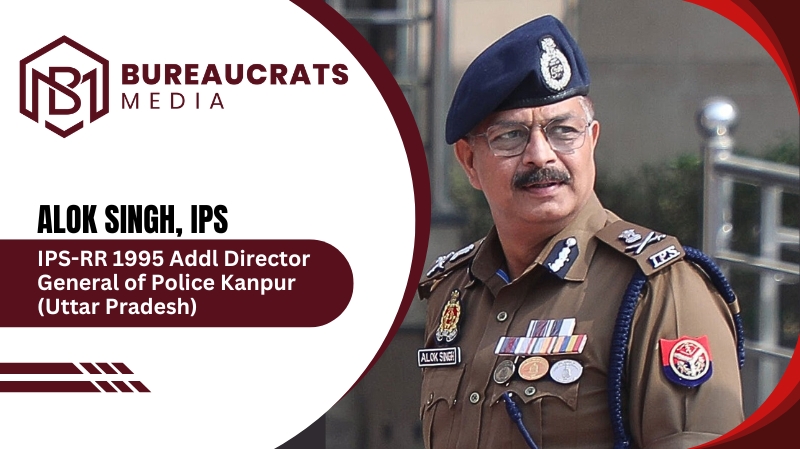
The timeless adage, “Whatever is worth doing at all is worth doing well,” resonates powerfully in the career of Alok Singh, a 1995-batch Indian Police Service (IPS) officer of the Uttar Pradesh cadre. Known for his quiet intensity, strategic clarity, and integrity in service, Singh today stands among the most respected figures in Uttar Pradesh’s policing architecture. Currently serving as Additional Director General (ADG) of the Kanpur Zone, his record is defined not by noise, but by measurable, enduring impact.
In the early 2000s, Singh was handpicked to lead a pivotal counter-insurgency operation in Sonbhadra, a region then plagued by Naxalite dominance. With PAC camps and police stations overrun, the situation demanded swift and surgical action. Under Singh’s leadership, three area committees were dismantled, looted arms were recovered, and a sense of control was restored. The effort earned him the President’s Police Medal for Gallantry in 2002.

His academic credentials mirror his professional discipline. Singh holds degrees in Physics and Mathematics, Economics, and an MBA in Marketing and Finance. He has undergone advanced training programs in Italy and at Cambridge University, UK—where he not only excelled but was also invited to mentor new IPS probationers, a rare distinction underscoring his intellectual and professional acumen.
Singh’s tenure as the first Commissioner of Police for Gautam Buddh Nagar (Noida) in 2020 marked a significant milestone in his career. Tasked with implementing the newly introduced commissionerate system in one of UP’s fastest-growing urban hubs, Singh laid the groundwork for modernised, responsive, and citizen-oriented policing.

His decorated service record includes the President’s Police Medal for Distinguished Service, the Utkrishta Seva Padak, and the DGP’s Commendation Discs in Silver, Gold, and Platinum. He has led from the front during key operations against terrorism in Saharanpur and criminal gangs in Kanpur and adjoining districts.
Alok Singh executed high-impact crackdowns on organised criminal networks. In a notable operation, an auto-lifters’ gang with a cache of 21 stolen motorcycles and arms was neutralised across Farrukhabad and Etawah. In parallel, his zonal command led to the arrest of 127 individuals under the Goonda and Gangster Acts, with assets worth crores seized across Auraiya, Jalaun, and Kanpur Dehat.
His leadership during the tense period surrounding the Ayodhya verdict, while posted as IG of Meerut Range, earned quiet praise for preserving communal harmony through tact and preparedness.

Alok Singh’s trajectory is not one of flamboyance but of steady ascent—marked by field-tested judgment, intellectual depth, and institutional integrity. Should he one day assume the role of Director General of Police, it would not merely crown a distinguished career; it would affirm the enduring relevance of principled, mission-focused leadership in Indian policing.