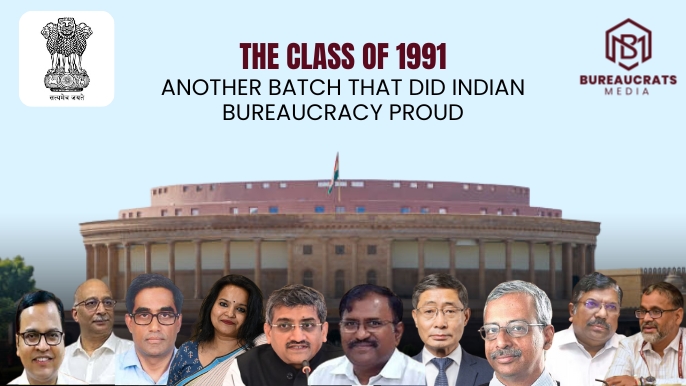
More than three decades after they entered public service, officers from the 1991 batch are today chief secretaries in multiple states. Each one of them backed by their extensive on-ground work and significant experience in crises managed, reforms delivered, and institutions strengthened. These are model officers who would be the source of inspiration to the younger generation of officers for years to come!
The IAS cohort of 1991.
These few remarkable officers from the Class of 1991 are now serving as chief secretaries in various states, bringing along a wealth of experience, overcoming challenges, implementing reforms, and fortifying institutions.
Currently, the officers of the 1991 IAS batch are at the pinnacle of state governance in India, influencing administrative practices in many states that have the potential to become India’s next growth engines.
From the strategic frontiers of Arunachal Pradesh and Manipur to the coastlines of Odisha, Andhra Pradesh and Tamil Nadu, from the reformative journey in Bihar to the intricate political landscape of West Bengal, this group is not only managing public service departments but has demonstrated what leadership is all about by managing multiple crisis situations over the years in their respective states.
What really connects them is not merely their rank, or even their common batch, but their dedication to their responsibilities, maintaining the dignity of their office and their extensive on-ground administrative experience.
These officers have:
- Started their careers as Sub-Collectors and District Magistrates, acquiring grassroots governance knowledge
- Overseen elections, responded to disasters, maintained law and order, and ensured public service delivery
- Managed areas such as finance, infrastructure, power, education, health, and social welfare
- Worked in both state and central roles, merging policy vision with practical execution
Each member brings unique strengths:
- Dr. Puneet Kumar Goel (Manipur) — He was earlier the Chief Secretary of Goa. His transfer to Manipur through inter-cadre deputation reflects both administrative flexibility and the Centre’s confidence in his leadership.
- Dr. Anu Garg (Odisha) — her exemplary professional integrity, work ethic and competence helped her break the proverbial glass ceiling to become the first woman chief secretary in the state ever.
- G. Sai Prasad (Andhra Pradesh) — The designated Chief Secretary has handled some of the state’s most complex portfolios and built a reputation with his professionalism, integrity and an ability to deliver in the most adverse situations.
- Manish Kumar Gupta (Arunachal Pradesh) — expertise in technical matters, urban governance, and strategic coordination
- Pratyaya Amrit (Bihar) — focus on building institutions, reviving infrastructure, and demonstrating ethical leadership
- Sentiyanger Imchen (Nagaland) — strong grassroots connections and comprehensive administrative expertise
- Manoj Pant (West Bengal) — deep understanding of policies, international exposure, and systemic thinking
- K. Ramakrishna Rao (Telangana) — commitment to financial prudence and governance driven by reforms
- N. Muruganandam (Tamil Nadu) — effective in executing welfare programs and facilitating industrial growth
- Dr. A. Jayathilak (Kerala) — a blend of academic prowess with leadership in the social sector
In the face of diverse political, social, and economic challenges, the 1991 batch demonstrates that experience is invaluable, continuity in institutions is essential, and that often, understated leadership can yield the most significant results.
As India confronts complex governance hurdles, these officers remind us that enduring change takes years at times even decades of dedicated public service.

IAS Dr. Puneet Kumar Goel — Chief Secretary of Manipur
Dr. Puneet Kumar Goel is a senior 1991-batch IAS officer of the AGMUT cadre, currently serving as the Chief Secretary of Manipur. He assumed charge in July 2025, following the appointment by the Appointments Committee of the Cabinet, at a time when the state’s administration required steadiness and clear direction.
He succeeded Prashant Kumar Singh and formally took over at the Old Secretariat in Imphal. His tenure is expected to continue until August 31, 2026, in line with his superannuation. Alongside his primary role, Goel also holds additional responsibilities as Chief Vigilance Commissioner of Manipur and Principal Resident Commissioner of Manipur Bhawan in New Delhi.
A career civil servant with wide-ranging experience, Goel has served across Union Territories and states in diverse and demanding roles. Before his move to Manipur, he was Chief Secretary of Goa, and immediately prior to that, Secretary to the National Commission for Scheduled Tribes (NCST). His transfer to Manipur through inter-cadre deputation reflects both administrative flexibility and the Centre’s confidence in his leadership.
Over the years, Goel has handled complex portfolios in urban governance, transport, water supply, municipal administration, and the energy and power sector, where he spent nearly a decade. His stints as CEO of the Delhi Jal Board, Transport Commissioner of Delhi, and Commissioner of South Delhi Municipal Corporation gave him deep exposure to large public systems and service delivery challenges.
Academically, Goel stands out for his strong technical foundation. An alumnus of IIT Kanpur and IIT Delhi, he also holds an MBA in Finance, an MS from the University of Southern California, and a PhD in renewable energy systems. This blend of engineering, finance, and policy expertise has shaped his methodical approach to administration.
Colleagues describe him as a calm, analytical, and steady administrator, known for balancing technical rigour with practical governance. In Manipur, where governance operates amid social and political sensitivities, his experience and composed leadership are seen as key strengths. As Chief Secretary, Dr. Goel continues to guide the state’s administration with focus on coordination, stability, and long-term institutional continuity

Dr. Anu Garg, a senior 1991-batch IAS officer of the Odisha cadre, has scripted history with her appointment as the first woman Chief Secretary of Odisha, marking a decisive moment in the state’s administrative evolution. Her elevation, notified in December 2025, comes as incumbent Manoj Ahuja demits office on December 31, making Garg the 47th Chief Secretary and breaking a glass ceiling that stood for decades in the state bureaucracy.
With more than three decades in public service, Garg brings to the post a rare mix of field experience, policy depth and institutional leadership. Prior to her appointment, she served as Development Commissioner-cum-Additional Chief Secretary, the second-highest administrative position in the state, and also held charge of critical portfolios such as Planning & Convergence and Water Resources. Notably, she was the first woman to be appointed Development Commissioner in Odisha in 2023.
Her career trajectory spans district, state and central governments. Beginning at the grassroots as Sub-Collector, she went on to serve as Collector and District Magistrate in districts including Sambalpur and Bargarh, earning a reputation for hands-on administration and community engagement. At the state level, she has steered key departments such as Health and Family Welfare, Women and Child Development, and Labour & ESI, handling complex welfare and governance challenges with quiet efficiency.
Garg’s central deputation further broadened her administrative canvas. She served as Joint Secretary in the Prime Minister’s Office (2012–2015), followed by senior roles in the Ministry of Textiles and the Ministry of Health and Family Welfare, gaining valuable exposure to national policy formulation and execution.
One of her most enduring contributions is Mission Shakti, Odisha’s flagship women’s self-help group movement, which she helped conceptualise and institutionalise, transforming it into a cornerstone of women’s economic empowerment in the state. A public health specialist, she has also contributed to national policy debates as a member of the High-Level Expert Group on Universal Health Coverage.
Academically accomplished, Garg is an alumna of Lady Shri Ram College, holds a master’s degree from the University of Lucknow, and an MPH from Johns Hopkins University. Colleagues describe her as measured, intellectually rigorous and consensus-oriented—an administrator who leads without theatrics. As she assumes office on January 1, 2026, expectations are that Dr. Anu Garg will provide steady, inclusive leadership at the helm of Odisha’s administration, blending experience with reform-minded continuity.

IAS G. Sai Prasad — Designated Chief Secretary of Andhra Pradesh
G. Sai Prasad, a senior 1991-batch IAS officer of the Andhra Pradesh cadre, has been formally named the next Chief Secretary of Andhra Pradesh. Government orders issued in late 2025 confirm that he will assume charge on March 1, 2026, following the extended tenure of the present incumbent, K. Vijayanand.
Prasad steps into the role after a long and varied administrative career that spans district administration, core infrastructure sectors and the highest levels of state decision-making. In recent years, he has been serving as Special Chief Secretary in the Water Resources Department and as Ex-officio Special Chief Secretary to the Chief Minister, positions that placed him at the heart of policy planning and execution. His elevation reflects both his seniority in the cadre and the confidence reposed in his ability to steer the administration through its next phase.
Within bureaucratic and political circles, Prasad is regarded as a calm, steady and low-profile administrator. Seen as a frontrunner for the top post well before the formal announcement, he has built a reputation for professionalism, integrity and an ability to work across governments and departments without friction.
An engineer by training, Prasad holds an M.Tech from IIT Delhi and a postgraduate degree in International Development Policy from Duke University, USA. He began his career in district administration, serving as Joint Collector of Warangal and later as Collector of Kurnool and Chittoor, experiences that grounded his understanding of field-level governance.
Over the years, he has handled some of the state’s most complex portfolios. His work in the power sector, including stints as CMD of major distribution companies, and his role as Chief Commissioner of Land Administration, underline his grasp of large systems and reform-driven governance. He has also served on central deputation as Joint Secretary in the Ministry of Power, adding a national policy perspective to his administrative toolkit.
Prasad’s close association with the Chief Minister’s Office—earlier as Principal Secretary to Chief Minister N. Chandrababu Naidu (2014–2019) and now in his current role—has given him a deep understanding of policy priorities and political-administrative coordination at the highest level.
Colleagues describe him as an officer who values clarity, preparation and balance. He is known to listen carefully, weigh options, and push for outcomes without noise. As Andhra Pradesh prepares for a leadership transition in early 2026, his appointment is widely seen as a bet on experience and continuity. His tenure as Chief Secretary is expected to focus on tighter coordination across departments, steady reform implementation and smooth execution of the state’s development agenda.

IAS Manish Kumar Gupta is the current Chief Secretary of Arunachal Pradesh. He is a 1991-batch IAS officer of the AGMUT cadre and took charge in September 2024. He brings long experience from both state and central postings.
Gupta studied civil engineering at IIT Kanpur and later public administration at Harvard. He began his education in a government school and often speaks about his simple beginnings, which connects him easily with students and young officers.
Before coming to Arunachal Pradesh, he worked in Delhi as Principal Secretary (Home) and also served as Vice Chairman of the Delhi Development Authority. There, he handled major urban and housing projects.
As Chief Secretary, he focuses on timely project reviews, filling staff gaps, and close monitoring of border and district issues. He is known for field visits, calm decision-making, and a people-friendly style. His approach reflects quiet leadership and steady governance.

IAS Pratyaya Amrit is the Chief Secretary of Bihar. He is a 1991-batch IAS officer of the Bihar cadre and took charge in September 2025. Over the years, he has built a reputation as a steady and reliable administrator.
He has handled several key departments, including health, energy, roads, and disaster management. One of his major contributions was reviving the Bihar State Bridge Construction Corporation when it was facing a serious financial crisis. Under his watch, road and bridge projects gained speed across the state.
During the COVID-19 pandemic, he led the health department at a critical time. Testing capacity was expanded, hospitals were strengthened, and the response was closely monitored. His work earned him the Prime Minister’s Award for Excellence in Public Administration.
Pratyaya Amrit is also known for improving power supply, even in remote areas. He is seen as a trusted officer with a strong grip on field realities. Calm in manner and clear in decisions, he believes in teamwork and follow-up.
Often described as people-oriented, he listens carefully and expects results. As Chief Secretary, he now carries the responsibility of guiding Bihar’s administration with experience, balance, and quiet confidence.

IAS Sentiyanger Imchen is the Chief Secretary of Nagaland. He is a 1991-batch IAS officer of the Nagaland cadre and took charge on August 1, 2025. He succeeded Dr. J. Alam. With more than three decades in public service, he is known for his steady approach and deep understanding of government work.
Imchen has spent much of his career handling finance and administration. Before becoming Chief Secretary, he served as Additional Chief Secretary (Finance) and Finance Commissioner. He is respected for his clear grip on budgets, planning, and welfare spending.
In his early years, he worked in district administration in Mokokchung and later as Deputy Commissioner of Mon district. These field postings shaped his practical style of governance. At the state level, he headed many key departments, including health, education, IT, law, labour, and public works.
As Finance Commissioner, he played a key role in launching welfare schemes like the Chief Minister’s Micro Finance Initiative, Health Insurance Scheme, and Life Insurance Scheme. These programmes helped thousands of families across the state.
Calm, disciplined, and detail-focused, Imchen believes in quiet work rather than loud claims. As Chief Secretary, he continues to guide Nagaland’s administration with experience, balance, and a strong sense of responsibility.

IAS Dr. Manoj Pant is the Chief Secretary of West Bengal. He is a 1991-batch IAS officer of the West Bengal cadre. He took charge on September 1, 2024. His term has been extended till December 31, 2025, a sign of the trust placed in him.
Dr. Pant brings long and varied experience to the role. Before this appointment, he served as Finance Secretary and also headed the Irrigation and Waterways Department. These roles placed him at the centre of key policy and spending decisions of the state.
Early in his career, he worked as District Magistrate in Murshidabad and North 24 Parganas. These field postings helped him understand people’s problems at close range. Officers who worked with him recall his habit of listening first and acting after careful thought.
His career also includes important assignments outside the state. He served as Private Secretary to former Union Finance Minister Pranab Mukherjee. Later, he worked as a Senior Adviser at the World Bank in Washington. There, he handled work linked to South Asian countries. This exposure added a global view to his administrative style.
Dr. Pant is known for his calm nature and steady decision-making. During difficult moments, he prefers balance over haste. As Chief Secretary, he focuses on smooth coordination between departments and steady progress on long-term projects.
Colleagues describe him as practical, fair, and detail-oriented. He values teamwork and expects clarity in work. Whether dealing with finance, land issues, or state-level planning, he keeps the focus on outcomes.
With strong academic grounding and decades of service behind him, Dr. Manoj Pant continues to guide West Bengal’s administration with quiet confidence and a strong sense of duty.

IAS K. Ramakrishna Rao, a 1991-batch Indian Administrative Service officer of the Telangana cadre, is among the state’s most seasoned administrators. He took charge as Chief Secretary of Telangana at the end of April 2025, succeeding A. Santhi Kumari, and continues to hold the crucial portfolio of Finance Secretary—a rare dual responsibility that reflects the confidence reposed in him.
Widely regarded as a master of public finance, Rao has an unmatched record of having prepared 14 state budgets over more than a decade. His stewardship of the Finance Department has been central to Telangana’s fiscal management, enabling the state to balance welfare commitments with development spending. He also played a key role in rolling out the Integrated Financial Management & Information System (IFMIS), strengthening transparency and financial control.
Rao’s career spans critical phases of state-building. During the bifurcation of Andhra Pradesh, he handled sensitive issues such as employee allocation and represented the state’s interests at national forums. His field experience as District Collector of Adilabad and Guntur grounded him in grassroots administration, while later roles—including Director of School Education and Director General of the Centre for Good Governance—sharpened his reform-oriented outlook. He has also served at the Centre as Joint Secretary in the Ministry of Information and Broadcasting and worked with multilateral institutions.
An engineer by training, with degrees from IIT Kanpur and IIT Delhi, and an MBA in Investments, Rao combines technical rigour with financial insight. As Chief Secretary, he is known for his calm demeanour, data-driven approach, and emphasis on coordination across departments. Colleagues describe him as steady, precise, and focused on execution.
At a time when Telangana is pushing ambitious goals such as the “Telangana Rising 2047” vision, Rao’s experience and measured leadership continue to provide stability and direction to the state’s administration.

IAS Thiru N. Muruganandam, a 1991-batch Indian Administrative Service officer of the Tamil Nadu cadre, assumed charge as the 50th Chief Secretary of Tamil Nadu on August 19, 2024, succeeding Shiv Das Meena. His appointment marked the culmination of a long and carefully built administrative career that spans fieldwork, policy formulation, and top-level advisory roles.
Before moving to the Secretariat’s highest office, Muruganandam served as Secretary-I to Chief Minister M.K. Stalin, placing him at the core of the state’s decision-making apparatus. He has handled some of Tamil Nadu’s most sensitive and consequential portfolios, notably Industries and Finance, where his work intersected directly with investment promotion, fiscal management, and welfare delivery. As Industries Secretary, he was retained across political regimes, a rare continuity that underscored confidence in his professional judgment. Even during the disruption of the COVID-19 period, he played a key role in sustaining investor interest in the state.
As Finance Secretary, Muruganandam worked closely with the political leadership on budgets and flagship schemes, including major social welfare initiatives. His grounding in district administration—as Collector of Coimbatore, Karur, and Chennai—gave him first-hand exposure to grassroots governance, sharpening his understanding of urban and rural challenges alike.
His career also includes central deputation as Joint Secretary in the Union Ministries of Shipping and Rural Development, and a stint as Principal Resident Commissioner in New Delhi, roles that broadened his administrative perspective beyond the state.
An engineer by training, with a degree in Computer Science from Anna University and an MBA from IIM Ahmedabad, Muruganandam brings analytical rigour to public administration. Within the bureaucracy, he is widely regarded as a straightforward, no-nonsense officer—measured in manner, clear in thought, and focused on outcomes rather than optics.
As Chief Secretary, he is seen as a coordinator rather than a controller, encouraging inter-departmental alignment and steady execution. His leadership reflects continuity, discipline, and a quiet confidence shaped by decades of service at every level of government.

IAS Dr. A. Jayathilak, a 1991-batch Indian Administrative Service officer of the Kerala cadre, currently serves as the 50th Chief Secretary of Kerala, having assumed office at the end of April 2025 following the retirement of Sarada Muraleedharan. He is expected to hold the state’s top bureaucratic position until his superannuation in June 2026.
Often described as a scholar-administrator, Jayathilak’s career stands out for its rare mix of academic depth and hands-on governance. A medical graduate from Thiruvananthapuram Medical College, he entered public service with his first posting as Sub-Collector of Mananthavady. Over more than three decades, he has moved steadily through some of the most demanding roles in the Kerala administration.
His tenure as District Collector of Kollam and Kozhikode earned him public recognition for initiatives that went beyond routine administration, including student-focused career guidance programmes and community engagement efforts. These early field experiences shaped an administrative style that values both people and process.
Jayathilak went on to play a significant role in shaping Kerala’s tourism story. As Managing Director of the Kerala Tourism Development Corporation, he was closely associated with efforts that helped brand “Kerala Tourism” on the global map. His work in this sector led to a central deputation, where he became the first Managing Director of the Chhattisgarh Tourism Board, building a new institutional framework from the ground up.
Within the state secretariat, he has handled several critical portfolios. As Additional Chief Secretary (Finance), he was involved in fiscal planning and oversight of major infrastructure and development programmes. He has also chaired national bodies such as the Spices Board and the Rubber Board, reflecting the breadth of his administrative exposure.
Colleagues describe Jayathilak as measured, thoughtful, and inclusive in his approach. Known for clear communication and steady decision-making, he is seen as an administrator who brings teams together and maintains continuity even in complex policy environments.
As Chief Secretary, he brings to the role a blend of intellectual rigour and practical experience, guiding Kerala’s administration through a phase that demands both stability and forward-looking governance.