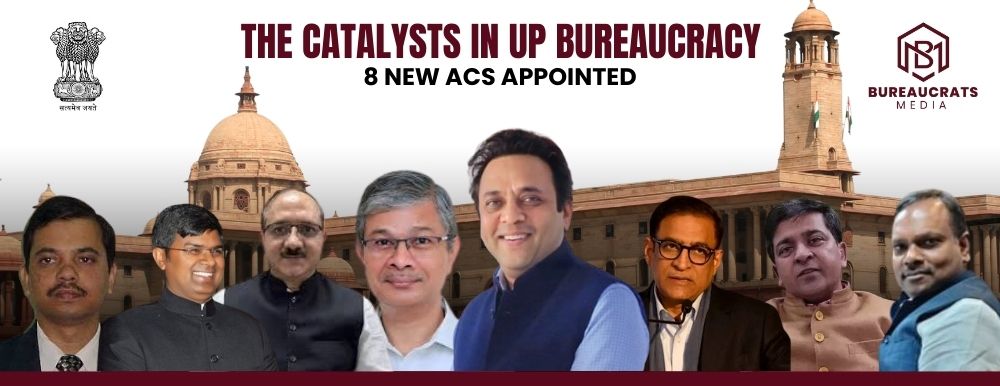
The Uttar Pradesh government on Monday (January 12, 2026) promoted eight IAS officers of the 1995 batch to the rank of Additional Chief Secretary (ACS), the highest echelon in the state’s bureaucratic hierarchy, corresponding to Level-17 of the Pay Matrix. Of these, three officers have been granted proforma promotions as they are currently on central deputation.
The officers elevated to the ACS rank are Ashish Kumar Goel, Sanjay Prasad, Amrit Abhijat, R. Ramesh Kumar, Mukesh Kumar Meshram, Bhuvnesh Kumar, Mritunjay Kumar Narayan, and Santosh Kumar Yadav. Among them, Bhuvnesh Kumar, Mritunjay Kumar Narayan, and Santosh Kumar Yadav have received proforma promotions.
Ashish Kumar Goel is presently serving as Chairman of the Uttar Pradesh Power Corporation Limited (UPPCL) and also holds additional charge of the Water Electric Corporation of Uttar Pradesh and the Uttar Pradesh State Electricity Production and Transmission Corporation.
Sanjay Prasad is currently posted as Principal Secretary to the Chief Minister and handles a clutch of sensitive and high-impact portfolios, including Home, Information, Protocol, Vigilance, Gopan, Visa and Passport, and Estate. Amrit Abhijat is serving as Principal Secretary, Tourism and Culture, with additional charge of the Religious Affairs Department.
R. Ramesh Kumar is currently working as a Member of the Board of Revenue, while Mukesh Kumar Meshram is serving as Principal Secretary of the Animal Husbandry, Dairy Development and Fisheries Department.
Among those on central deputation, Bhuvnesh Kumar is posted as Additional Secretary in the Ministry of Electronics and Information Technology (MeitY). Mritunjay Kumar Narayan is serving as Registrar General of India and Census Commissioner under the Ministry of Home Affairs, while Santosh Kumar Yadav is the Chairman of the National Highways Authority of India (NHAI).
All eight officers bring with them decades of administrative experience across district, state, and central assignments. Their elevation comes at a time when the state government is pushing an ambitious governance and development agenda. Going forward, their performance will be closely watched, as their roles become central to translating the Chief Minister’s vision into on-ground outcomes.

Sanjay Prasad, IAS (1995 batch, Uttar Pradesh cadre)
Sanjay Prasad, a 1995-batch IAS officer of the Uttar Pradesh cadre, has emerged as one of the most influential bureaucrats in the state’s administrative hierarchy. Known for his firm grip on governance and his ability to navigate complex political-administrative intersections, Prasad combines operational discipline with a strong command over communication and institutional processes.
Born on May 23, 1971, in Sitamarhi, #Bihar, Prasad holds a Master of Arts degree and entered the civil services in 1995. His early career included stints as Assistant Magistrate in Azamgarh and Chief Development Officer in Gorakhpur assignments that helped shape his hands-on approach to district administration. Over the years, he has served as District Magistrate in key and sensitive districts such as #Agra, #Prayagraj, #Ayodhya, and Firozabad, where he dealt with a mix of urban pressures, religious sensitivities, and law-and-order challenges.
Prasad’s administrative reach expanded further during his central deputation between 2015 and 2019, when he served as Joint Secretary in the Ministry of Defence. The assignment added a strategic dimension to his profile, equipping him with exposure to national security frameworks and high-level policy coordination.
In January 2026, he was promoted to the rank of Additional Chief Secretary (ACS), cementing his position among the top echelon of Uttar Pradesh’s bureaucracy. Currently, he serves as Additional Chief Secretary to Chief Minister Yogi Adityanath, a role that places him at the nerve centre of state governance. He simultaneously oversees a cluster of powerful portfolios, including the Chief Minister’s Office, Home Department, Information and Public Relations, Confidential and Vigilance, Visa and Passport, and Protocol and Estate.
Widely regarded as a key figure in the Chief Minister’s inner circle, Prasad is often described as a decisive administrator with a sharp eye for execution. His reputation as a “taskmaster” stems from his insistence on timelines, digital monitoring systems, and measurable outcomes. Tech-savvy and detail-oriented, he has been instrumental in streamlining internal communication and strengthening the state’s public outreach machinery.
Equally noted is his firm handling of law and order related matters, where he has prioritised coordination between the police, intelligence units, and district administrations. Insiders say his strength lies in his ability to translate political directives into executable administrative action without diluting institutional protocols.
Despite his high profile position, Prasad is known for maintaining a low public profile. His leadership style is functional rather than flamboyant focused more on control rooms than conference halls. Among colleagues, he is seen as a steady hand who values discipline, clarity, and chain-of-command.
In an era where bureaucracy is increasingly under public and political scrutiny, Sanjay Prasad represents a school of administrators who believe in tight governance, controlled communication, and uncompromising execution qualities that have made him both indispensable and formidable within Uttar Pradesh’s power structure.

Dr. Ashish Kumar Goel, IAS (1995 batch, Uttar Pradesh cadre)
Dr. Ashish Kumar Goel, a 1995-batch IAS officer of the Uttar Pradesh cadre, is widely regarded as a cerebral administrator who brings academic depth to practical governance. A native of Bijnor, Goel’s educational credentials BTech in Electrical Engineering from IIT Delhi, a Master’s degree in Economics, and a PhD in the same discipline have shaped his preference for data-led policy making and institutional reform.
Over nearly three decades in public service, he has navigated a broad administrative canvas, spanning district leadership, infrastructure planning, rural development, and large public utilities. His tenure as Divisional Commissioner of Prayagraj remains a significant chapter, most notably for the successful organisation of the Kumbh Mela 2019 an effort that earned him the Prime Minister’s Award for Excellence in Public Administration. The scale and complexity of the event highlighted his ability to combine meticulous planning with decisive execution.
Dr. Goel has also served as Secretary (Rural Development), Director of the State Agriculture Production Mandi Parishad, and Managing Director of the Uttar Pradesh State Road Transport Corporation (UPSRTC), positions where he focused on streamlining operations, strengthening public-facing services, and improving institutional efficiency. Earlier in his career, he held charge as District Magistrate of Jalaun and Bahraich, where he earned a reputation for hands-on administration and swift grievance redressal.
His experience extends beyond the state, having served on central deputation as Additional Secretary in the Union Ministry of Rural Development and as Director General of the National Rural Infrastructure Development Agency (NRIDA). It was during his work on NREGA implementation that The Economist in 2008 described him as among the “hardest working bureaucrats in the world,” a rare international acknowledgment for an Indian civil servant.
In January 2026, Dr. Goel was promoted to the rank of Additional Chief Secretary. He continues to serve as Chairman of the Uttar Pradesh Power Corporation Limited (UPPCL), a position he assumed in July 2023, and also heads the UP Power Transmission Corporation Limited (UPPTCL). In these roles, he has prioritised consumer responsiveness, system accountability, and operational transparency—key areas in a sector that directly impacts millions of households.
Colleagues describe him as methodical, understated, and deeply invested in outcomes rather than optics. His leadership style is marked by technical precision, institutional memory, and a quiet empathy for citizen concerns an approach that has helped him command credibility across political, bureaucratic, and stakeholder circles.
Born on February 12, 1973, Dr. Goel represents a generation of administrators who balance scholarship with street-level governance an officer equally comfortable with spreadsheets and public hearings.

Santosh Kumar Yadav, IAS (1995 batch, Uttar Pradesh cadre)
Santosh Kumar Yadav, a 1995 batch IAS officer of the Uttar Pradesh cadre, has built a career that straddles infrastructure development, urban governance, and public administration. Trained as a civil engineer, he brings a technocrat’s precision to policymaking and project execution an approach that has defined his work across three decades in public service.
Born on January 19, 1971, in Firozabad, Uttar Pradesh, Yadav holds a B.Tech in Civil Engineering from IIT Roorkee and an M.Tech from IIT Delhi. This academic grounding has shaped his long-standing association with large-scale infrastructure and transport projects.
Since late 2022, he has been serving as Chairman of the National Highways Authority of India (NHAI), one of the country’s most critical infrastructure agencies. He formally took charge on January 2, 2023, and in early 2025, his central deputation was extended by two years, till February 2027 an endorsement of continuity at a time when India’s highway network is undergoing rapid expansion. Under his leadership, NHAI has emphasised sustainable construction practices, technology-driven monitoring, and faster project delivery.
Prior to his current role, Yadav served as Additional Secretary in the Department of School Education and Literacy in the Ministry of Education, where he worked on national level education programmes and institutional reforms. This shift from physical infrastructure to human capital development added a broader policy dimension to his administrative profile.
In Uttar Pradesh, Yadav has held several influential assignments. He served as Secretary to the Chief Minister in 2015, Managing Director of the Noida Metro Rail Corporation in 2017, and Chief Executive Officer of the Yamuna Expressway Industrial Development Authority (YEIDA). Between 2012 and 2015, he was Vice Chairman and later Chairman of the Ghaziabad Development Authority, where he was closely associated with major urban infrastructure and transport initiatives.
His district-level experience is equally extensive. He has served as District Magistrate in strategically important districts such as Ghaziabad, Gautam Budh Nagar (Noida), Bareilly, Aligarh, Muzaffarnagar, and Lalitpur assignments that tested both his administrative agility and his ability to manage rapid urbanisation, law and order challenges, and public service delivery.
Colleagues describe Yadav as a detail-oriented administrator with a strong preference for execution over rhetoric. His leadership style is structured, data-driven, and outcomes focused qualities that have made him a natural fit for roles involving large public systems and long-gestation projects.
At a time when infrastructure is central to India’s growth narrative, Santosh Kumar Yadav stands out as an administrator who combines engineering logic with bureaucratic experience an officer who has spent much of his career building systems, corridors, and institutions that quietly underpin everyday mobility and economic activity.

Amrit Abhijat, IAS (1995 batch, Uttar Pradesh cadre)
Amrit Abhijat, a 1995-batch IAS officer of the Uttar Pradesh cadre, has carved out a reputation as a policy oriented administrator with a strong grounding in urban development, tourism, and large scale public programmes. His career reflects a consistent effort to balance heritage conservation with modern governance imperatives, particularly in culturally significant regions of the state.
Educated in history at Delhi University’s Kirori Mal College and later trained in development studies at the University of Sussex in the UK, Abhijat brings an academic sensibility to public administration. This grounding has informed his work across sectors, especially in housing, urban planning, and cultural management.
In January 2026, he was promoted to the rank of Additional Chief Secretary, a recognition of his long-standing contributions to governance. He currently serves as Principal Secretary in the Department of Tourism, Culture, and Religious Affairs, where he oversees policy formulation and execution in areas that sit at the intersection of faith, heritage, and economic development.
Abhijat’s administrative experience spans both state and central governments. At the Centre, he played a key role as Mission Director of the Pradhan Mantri Awas Yojana (Urban), contributing to the design and rollout of one of the country’s largest affordable housing initiatives. In Uttar Pradesh’s Urban Development Department, he introduced the “One City, One Operator” model for sewer management an effort aimed at improving accountability and service efficiency.
His district level stints as District Magistrate in #Prayagraj, #Kanpur, #Agra, and #Jhansi exposed him to a wide range of governance challenges, from infrastructure and civic management to law and order and public grievance redressal. These postings helped shape his reputation as a field-tested administrator capable of handling politically sensitive and logistically demanding assignments.
Abhijat has also been closely associated with the management of large public events and urban transformation projects, including the Mahakumbh and development initiatives in Ayodhya. Colleagues describe his approach as structured, historically sensitive, and forward-looking particularly valuable in locations where tradition and modernity must coexist.
Originally from Munger in Bihar, he is known within bureaucratic circles as a measured decision-maker who prefers institutional solutions over ad hoc interventions. His leadership style is understated but firm, driven more by policy depth than public visibility.
In a bureaucracy often shaped by immediacy and optics, Amrit Abhijat represents a quieter, more scholarly strain of governance one that privileges long-term planning, cultural stewardship, and system building over headline-grabbing interventions.

Mukesh Kumar Meshram, IAS (1995 batch, Uttar Pradesh cadre)
Mukesh Kumar Meshram, 1995 batch IAS officer of the Uttar Pradesh cadre, is widely regarded as one of the state’s most versatile and institutionally rooted administrators. With academic training that bridges design and governance an M.Arch from IIT Roorkee and a Master of Public Administration from the University of Birmingham Meshram brings both structural thinking and public-policy sensibility to his work.
In January 2026, he was promoted to the rank of Additional Chief Secretary (ACS), a recognition of his three-decade-long contribution to governance. He currently heads the Animal Husbandry, Dairy Development, and Fisheries departments, where he has focused on inclusive policy frameworks, sectoral modernisation, and livelihood linked reforms.
Meshram’s administrative career has been marked by its breadth. Between 2020 and 2025, as Principal Secretary for Tourism and Culture, he played a pivotal role in repositioning Uttar Pradesh on the global tourism map. He was the principal architect behind the early planning of Mahakumbh 2025 and helped conceptualise cultural initiatives that blended faith, heritage, and economic development. Under his watch, tourism policy increasingly reflected a balance between conservation and contemporary visitor management.
His earlier stints as Divisional Commissioner in both Lucknow and Prayagraj placed him at the helm of two of the state’s most complex administrative regions. At the district level, he has served as District Magistrate and Collector in a wide range of districts Kanpur, Agra, Meerut, Mau, Unnao, Banda, and Azamgarh each with its own social and political dynamics. These postings cemented his reputation as a steady, field-oriented administrator with a strong grasp of grassroots governance.
Meshram has also handled several critical portfolios, including Secretary of Medical Education, Commissioner of Commercial Tax, Managing Director of UPSRTC, and Mission Director of the National Rural Health Mission (NRHM). Across these roles, colleagues describe him as a system-builder an officer more invested in strengthening institutions than chasing visibility.
What sets Meshram apart, however, is the personal dimension he brings to leadership. Born on June 26, 1967, in Bori village of Madhya Pradesh’s Balaghat district, he often recalls crossing a river daily to attend school—an anecdote he shares with young aspirants to underline the value of perseverance. His involvement in initiatives supporting para-judo and animal welfare reflects a sensibility that extends beyond files and frameworks.
In an era of headline-driven governance, Mukesh Kumar Meshram belongs to a quieter tradition of administrators those who work steadily behind the scenes, shaping systems that outlast tenures. His career is a study in institutional continuity, cultural stewardship, and humane administration.

Bhuvnesh Kumar, IAS (1995 batch, Uttar Pradesh cadre)
Bhuvnesh Kumar, a 1995 batch IAS officer of the Uttar Pradesh cadre, has emerged as a key figure in India’s evolving digital governance architecture. A gold medallist in Electronics and Communication Engineering from the National Institute of Technology, Kurukshetra, Kumar brings a rare blend of technical grounding and administrative depth to public service.
As of January 2026, he serves as the Chief Executive Officer of the Unique Identification Authority of India (UIDAI), the statutory body responsible for Aadhaar, while simultaneously holding charge as Additional Secretary in the Ministry of Electronics and Information Technology (MeitY). He assumed charge as CEO, UIDAI, on January 1, 2025, succeeding Amit Agrawal. His elevation to the rank of Additional Chief Secretary by the Uttar Pradesh government earlier this year, albeit on a proforma basis, reflects long-standing institutional confidence in his capabilities.
Kumar’s career has traversed both state and central administrations, giving him a perspective that is at once grassroots-oriented and policy-driven. In Uttar Pradesh, he has held a wide array of key assignments, including Principal Secretary in the Animal Husbandry, Dairy Development, and Fisheries Department, and Divisional Commissioner of Lucknow and Meerut two of the state’s most administratively demanding regions.
At the district level, he has served as District Magistrate in strategically significant districts such as Lucknow, Aligarh, Ayodhya, Bareilly, and Meerut. These postings sharpened his understanding of public delivery systems, law-and-order management, and citizen-facing governance.
Within the state secretariat, Kumar has handled important portfolios including Finance, MSME, Technical Education, and Sports and Youth Welfare. These roles allowed him to engage with both economic policy and human capital development, reinforcing his reputation as an officer comfortable with complex, multi-sectoral mandates.
On central deputation, Kumar has steadily built his profile in India’s digital policy ecosystem. He served as Joint Secretary in MeitY before being promoted to Additional Secretary in 2022, and later entrusted with the leadership of UIDAI one of the country’s most critical technology-driven public institutions. His current work focuses on strengthening digital identity systems, data security, and inclusive access to public services.
Colleagues describe him as low-key, technically astute, and structurally minded an officer who prefers building systems over chasing visibility. His leadership style is marked by precision, institutional memory, and a quiet confidence born of experience across governance tiers.
In an era where public administration is increasingly shaped by technology, Bhuvnesh Kumar represents a generation of civil servants who understand both the code and the citizen an administrator as comfortable in policy rooms as he once was in district collectorates.

Mritunjay Kumar Narayan, IAS (1995 batch, Uttar Pradesh cadre)
Dr. Mritunjay Kumar Narayan, a 1995 batch IAS officer of the Uttar Pradesh cadre, has built a career at the intersection of governance, technology, and national security. An IIT-trained engineer with advanced academic grounding in public policy, law, and management, he is widely regarded as an administrator who brings analytical depth to some of the most complex domains of public administration.
Since November 2022, he has been serving as the Registrar General and Census Commissioner of India under the Ministry of Home Affairs a role central to the country’s demographic mapping and policy planning. His tenure has been extended until August 2026, underlining the government’s confidence in his leadership as India prepares for the upcoming Census 2027. In early January 2026, he formally issued notifications outlining the roadmap for the next census, with houselisting operations scheduled to begin nationwide from April 2026.
Dr. Narayan’s academic credentials mirror the breadth of his administrative work. He holds http://B.Tech and http://M.Tech degrees in Electrical Engineering from IIT Kanpur, an MSc in Public Policy and Management from King’s College London, an LL.B. from Lucknow University, and a doctorate from the Norwegian University of Science and Technology. This rare combination of technical, legal, and policy training has shaped his approach to governance precise, data driven, and institutionally anchored.
Before taking charge of the census, he served as Additional Secretary in the Ministry of Home Affairs, handling sensitive portfolios related to internal security and cyber information systems. Earlier, between 2019 and 2021, he was Joint Secretary in the Ministry of Power, overseeing transmission and IT-related verticals an assignment that blended infrastructure planning with digital transformation.
In Uttar Pradesh, he has served as Secretary to the Chief Minister and as Commissioner of Commercial Tax and Entertainment Tax, roles that required both political dexterity and fiscal oversight. He has also represented the government on the boards of key public sector entities such as the Security Printing and Minting Corporation of India Limited (SPMCIL), Power Grid Corporation of India, and REC Limited.
In January 2026, the Uttar Pradesh government granted him a proforma promotion to the rank of Additional Chief Secretary, acknowledging his long-standing service and central contributions.
Colleagues describe Dr. Narayan as understated, sharply analytical, and strategically minded an officer more comfortable in war rooms than in public glare. His work reflects a preference for systems-building over spectacle, and long-term institutional continuity over short-term gains.
At a time when governance is increasingly driven by data, digital infrastructure, and security considerations, Mritunjay Kumar Narayan stands out as a civil servant uniquely equipped for the age an administrator who speaks the language of both code and constitutional process.

R. Ramesh Kumar, IAS (1995 batch, Uttar Pradesh cadre)
R. Ramesh Kumar, a 1995-batch IAS officer of the Uttar Pradesh cadre, represents a generation of administrators shaped by long years of district-level governance and steady progression through the state’s senior bureaucracy. His career has unfolded largely away from the spotlight, marked instead by a reputation for consistency, institutional discipline, and a methodical approach to public administration.
In January 2026, Kumar was promoted to the rank of Additional Chief Secretary (ACS), a milestone that underscores the confidence reposed in him by the state government. He currently serves as a Member of the Board of Revenue, Uttar Pradesh, while continuing as Principal Secretary of the Silk (Sericulture) Department a portfolio he has led since 2022. The combination of these roles places him at the intersection of policy oversight and sector-specific administration.
An engineer by training, with a Bachelor’s degree in Mechanical Engineering and an MBA from the Indian Institute of Management, Kumar brings a structured, systems-driven mindset to governance. Over the years, he has served as Divisional Commissioner in Bareilly and Prayagraj, handling complex administrative landscapes that demanded coordination across multiple departments.
His field experience is extensive. As District Magistrate and Collector, he has been posted in a wide range of districts, including Ghaziabad, Bareilly, Muzaffarnagar, Ghazipur, Moradabad, and Etawah. These assignments exposed him to varied social, economic, and law-and-order environments, shaping him into an officer known for steady crisis management and quiet problem solving.
Within the secretariat, Kumar has held key positions such as Secretary of the Higher and Secondary Education Department and Special Secretary to the Chief Minister, roles that required both political sensitivity and administrative clarity. His work in these capacities earned him a reputation for balanced decision-making and institutional continuity.
Among peers, he is often described as an officer who prefers process over publicity. His leadership style is understated, focused on outcomes rather than optics. In 2008, The Economist reportedly described him as among the “hardest working bureaucrats in the world” during his tenure in Uttar Pradesh a rare international acknowledgment that added weight to his standing within administrative circles.
While he has maintained a low public profile, Kumar’s career reflects the quiet authority of an officer trusted with continuity, stability, and long-term governance. In a bureaucracy increasingly shaped by speed and spectacle, he belongs to a school of administrators who value structure, patience, and institutional memory.